CLASSICAL POETRY × GENERATIVE AI
Lost in the Moonlight?
Generative AI and the Cross-Lingual Reconstruction of Classical Chinese Poetic Imagery: A Case Study of the “Moon” Image
CALLIGRAPHY · POETRY · INQUIRY
Yangyang Liu 刘洋扬
Learning from the old masters. Exploring how words and images carry meaning across cultures.
A brush, a page, a continuing conversation.

01 / THE PRACTICE
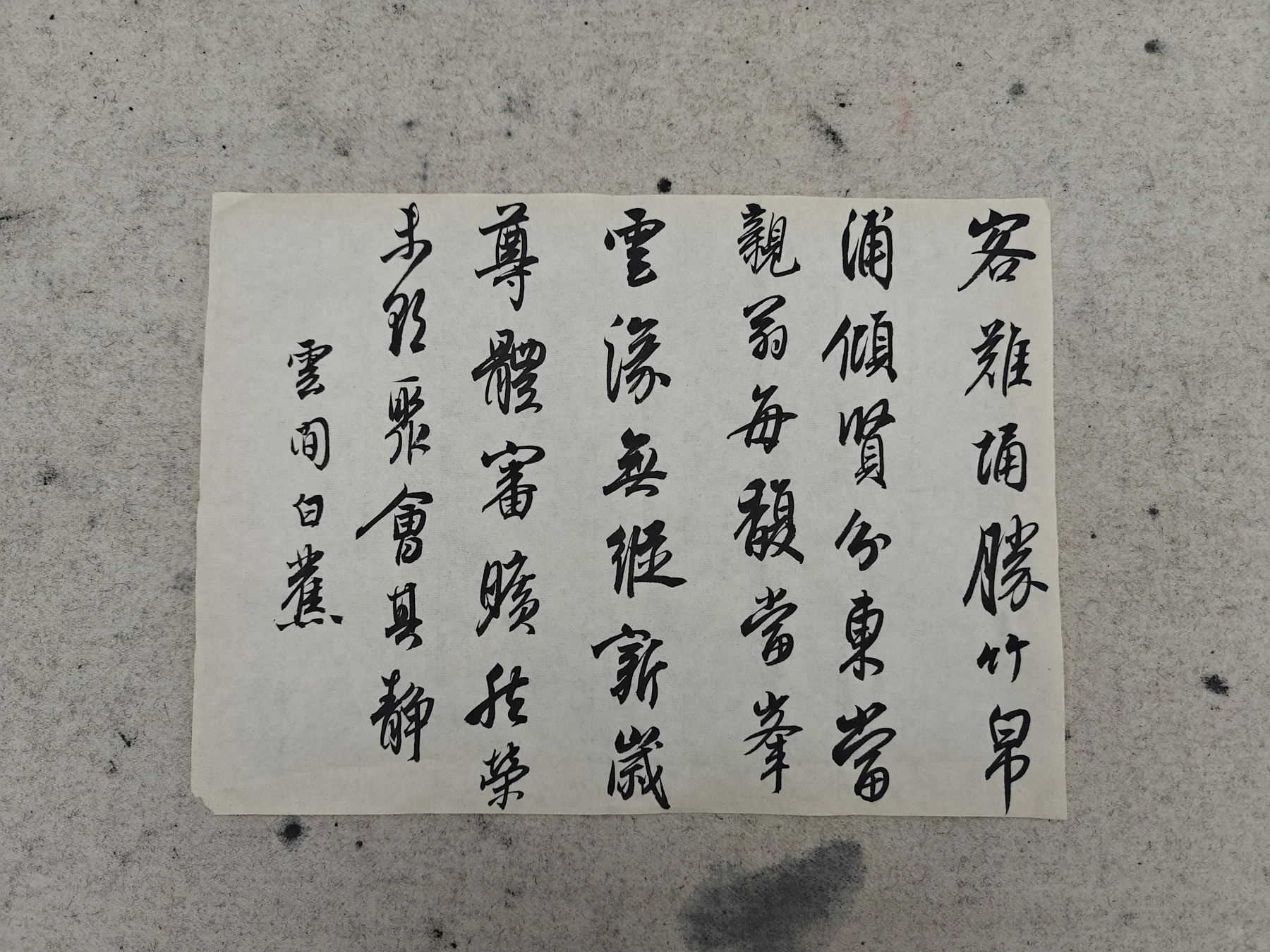
A selection of study sheets and visual references: close attention to the line, the rhythm, and the space between.
Selected calligraphy practice photographs from my collection.
02 / A CONTINUING EDUCATION
My interest in calligraphy began at five, when my father placed a water-writing cloth in our living room. At seven, I began studying Zhao Mengfu’s regular script with a calligrapher, a practice I continued until thirteen.
At boarding school, I continued independently with Chu Suiliang. Later, I turned to Wang Xizhi’s cursive and running scripts, and explored works by Yang Ningshi, Wang Xianzhi, and Mi Fu.
A water-writing cloth at home sparked a lasting interest in calligraphy.
Zhao Mengfu’s regular script: Sanmen Ji and Xianju Fu.
Chu Suiliang’s regular script: Yanta Shengjiao Xu, Ni Kuan Zan, Da Zi Yinfu Jing, and Yique Fokan Bei.
Wang Xizhi’s Shiqi Tie and running-script works, including Sangluan Tie, Kuaixue Shiqing Tie, Deshi Tie, Youxuan Tie, and Lanting Ji Xu.
Yang Ningshi’s Jiuhua Tie; Wang Xianzhi’s Zhongqiu Tie; Mi Fu’s Shusu Tie and Tiaoxi Shi Tie.
03 / RECENT RESEARCH
One image.
Many meanings.
A question of translation.
CLASSICAL POETRY × GENERATIVE AI
Generative AI and the Cross-Lingual Reconstruction of Classical Chinese Poetic Imagery: A Case Study of the “Moon” Image
04 / GET IN TOUCH
For conversations about calligraphy, classical poetry, and cultural exchange.